
Honda Scooters – Every Model, Every Year
This page contains a year by year overview of Honda’s scooter lineup in the USA and Canada. For detailed information on a specific Honda scooter, use the menu to the right.
 Honda’s diverse scooter history includes the 1954 Juno KA (189cc 4-stroke available only in Japan), the Cub (the world’s best selling vehicle of all time) and quite a few neat mopeds. However, this site is focused only on the “modern” scooters that came to North America beginning in the early 80’s.
Prior to modern scooters arriving here, Honda achieved success in the late 70’s with their P50 and Express lines of mopeds. To the Japanese, ‘modern scooters’ were the next logical step after mopeds and they set about working on this concept in the late 1970’s. Modern scooters went a step beyond mopeds by offering added convenience (i.e. enclosed storage) and a design that was much easier to live with (auto-choke, electric start, oil injection) and offered protection from the wind (via the leg shield) and dirtier parts of the bike via panels.
The first product they developed was the NB50, which was called the Tact in Japan. This scooter was released for the 1980 model year in Japan. It was an updated version of this scooter called the Aero 50 that arrived in the USA and Canada for the 1983, alongside the larger Aero 80 scooter. At the same time, Honda also designed a more conservatively styled scooter based on their Express line of mopeds. This cross-over moped/scooter was badged the Express SR and featured most of the conveniences of a modern scooter except enclosed storage and full side panelling.

 1981 – 1982
Honda made their first quasi-scooter foray into Canada and the USA with the moped based Express SR. The electric start, oil injection, 12 volt electronics, CVT (continuously variable transmission) and auto-choke were all amazing innovations at the time in machines this small.
The Express SR returned virtually unchanged for 1982 – its final year. Going forward Honda would instead focus on their futuristic scooter designs in the North American market.
MODELS: Express SR
1983
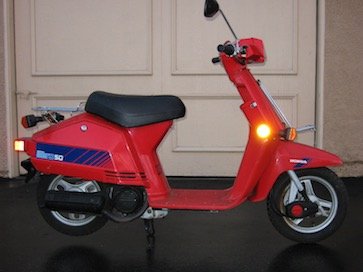 This was the first year Honda’s fully modern generation of scooters arrived in North America. In the USA, Honda decided to use the ‘Aero’ name for this family of scooters, so they named the NB50 the ‘Aero 50’ and the larger NH80 became the ‘Aero 80’. In Canada, Honda also used the Aero moniker but a few ’83 NH80’s received the ‘Mascot’ name instead for whatever reason.
The Aero family of scooters included several noteworthy features including electric start, enclosed storage, plastic body panels, oil injection and 12 volt electrical systems. While some of these features had been available previously on other scooters, they never had been all available at once and for such an affordable price. Viewed by some as cheap, the plastic body panels were affordable, ding resistant and easy to replace in the event of a crash.
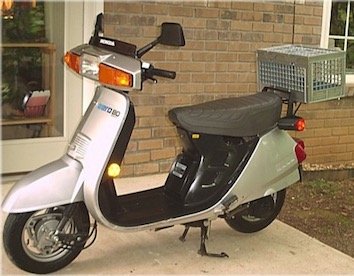 The Aero 50 (above) was a 2-stroke, 50cc offering decent acceleration and a top speed around 35-40 mph. The Aero 80 (left) wasn’t that much faster with a top speed around 43mph, but it was even peppier so it’s great for 2-up riding. The Aero 80 has enough power to wheelie and that power in combination with its comfortable seat and beefed up suspension makes it a great choice for 2-up riding or for bigger riders. These scooters are also incredibly reliable. I’ve talked to one owners with over 60,000 kms (37,000 miles) on the original non-rebuilt. Once downside to these initial offerings from Honda is the lack of aftermarket parts that the subsequent generations of Honda scooters enjoy. Check out the specific model pages for more indepth info on these scooters.
MODELS: Aero 50, Aero 80 / Mascot
1984
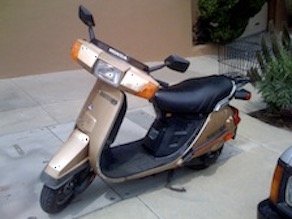 This was another landmark year with Honda adding four more scooters. Honda added the third and final member of the 2-stroke Aero family, the short lived Aero 125. Sadly Canadians and Californians weren’t offered this scooter. This scooter was only sold in 1984 so it’s quite a rare scooter. It’s surprising that Honda chose to introduce the Aero 125 at all because Honda was clearly moving to 4-stroke motors for all but their 50cc scooters.
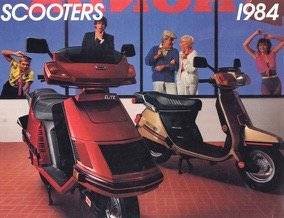
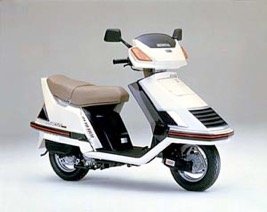 Honda also added another 125cc and their first 4-stroke scooter, the Elite 125 (below). This scooter was the first member of the Elite family that would figure prominently in Honda’s scooter lineup for decades to come.
The Elite 125 was the first look at a new generation of styling that Honda would continue to unveil in the form of the Elite 80 and Elite 250. One neat aspect of the Elite 125 is that it had a pop up headlight.
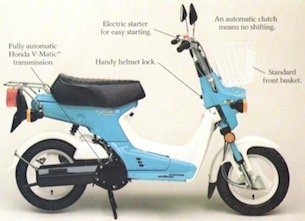
Honda’s other two new scooters were the remarkably small Spree (NQ50) and the unique NN50 3-wheeled Gyro (pictured right in blue). Both of these scooters used 2-stroke 50cc engines and were capable of 30mph.
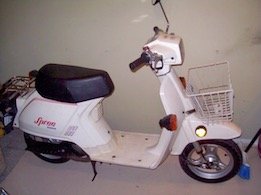
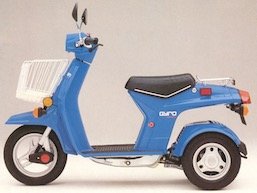
MODELS: Aero 50, Aero 80, Aero 125 (USA only), Spree, Gyro, Elite 125
1985
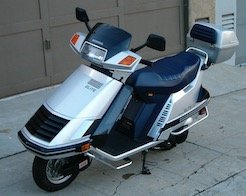 For 1985 Honda’s 4-stroke Elite series arrived in full force. Honda added the Elite 80, the Elite 250 and updated the mid-sized Elite. Click here to download a PDF of Honda USA’s 1985 Scooter Lineup. The mid-sized Elite got a boost from 125cc to 150cc and thus a name change to the Elite 150 (CH150). The extra 25cc boosted the top speed by 10mph to 65mph and made it interstate legal in all 50 states and Canada. The Elite 150 got a nice style update with a new handlebar mounted headlight instead of the pop up unit. By moving the headlight to the handlebars, Honda was able to add a handy front truck.
Honda also added a ‘Deluxe’ version of the Elite 150, which got a digital dash and retained the Elite 125’s pop up headlight. The regular Elite 150 had analog instrumentation.
 The new Elite 80 was a nicely powered scooter for around town. While not quite as peppy off the line as the Aero 80, it actually has a faster top speed of 45mph. It also had a front trunk like the Elite 150 that was capable of swallow a few small items. Storage space is okay but it’s not a strong point for this scooter.
With the Elite 250, Honda finally had a scooter that was at home on the highway. The Elite 150 could survive on the highway in a pinch, but the Elite 250 could comfortably cruise at highway speeds without a fuss. The Elite 250’s motor is a low stress design that can happily cruise at 70mph all day.
 Honda also updated the Aero 50 and Aero 80. The Aero 50 got a full redesign, while the Aero 80 got a few styling updates and a new smaller muffler which made the neat storage compartment in the right side panel possible.
The Gyro was also radically changed for ’85. Honda sold eight different three wheeled scooters in the Gyro family in Japan and for ’85 they decided to bring over a different member to the USA. Canadians did not get the Gyro after ‘84. This version is called the ‘Road Fox’ (TG50) in Japan. Check out the Gyro page for more info. This new Gyro shared the same core engine as the earlier Gyro, but the styling was quite different which warranted a change in the model code to TG50.
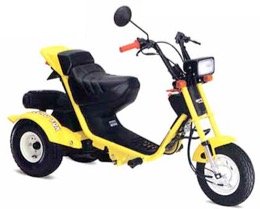 1985 was also the year Honda began replacing the Aero family with the Elite line of scooters. The first Aero scooter to be discontinued was the slow selling Aero 125. Apparently scooter buyers had preferred the 4-stroke Elite 125 in 1984 or Honda had simply decided 4-strokes were the future. 1985 was another popular year for Honda scooters with an all time high of seven models available.
MODELS: Aero 50, Aero 80, Spree, Gyro (USA only), Elite 80, Elite 150, Elite 250
1986
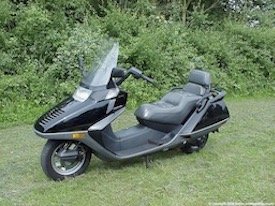 For 1986, new emissions regulations, Honda’s preference for 4-strokes and the popularity of the 4-stroke Elite 80 spelled the death for the peppy Aero 80. This left the Aero 50 as the lone surviving member of the Aero family in North America.
This year Honda also added the original maxi-scooter, the Helix (CN250), to their North American lineup. Based on the Elite 250, the Helix was lower, longer and featured a really cool trunk which made it a great long distance touring scooter.
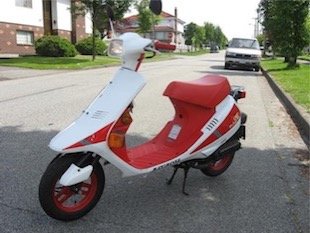 For 1986 Honda dropped the regular version of the Elite 150 and offered just the ‘deluxe’ version.
Using the ‘Elite R’ name, Honda introduced their 2-stroke SE50 scooter to Canadian market. It would be another year before Americans got this scooter. In some literature, Honda referred to this scooter as the ‘Aero Sport RR’. The Elite R shares the same AF05E engine found the Aero 50 (NB50) but it has a new frame and bodywork. The Elite R would eventually replace the Aero 50 in Canada.
MODELS: Aero 50, Elite R (Canada only), Spree, Gyro (USA only), Elite 80, Elite 150, Elite 250, Helix
1987
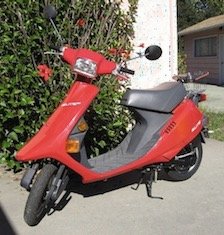 A year after its Canadian debut, Honda released the SE50 in the USA (shown left). Here this scooter was badged as the ‘Elite S’. The Elite S did not have sporty graphics that Canadians got on their Elite R’s. Honda also sold a restricted version of the SE50 (only in the USA) called simply the ‘Elite’ (Code: SE50P). This scooter was capable of 25 mph which made it moped legal in many states.
Further trimming their lineup, Honda dropped the Gyro from their USA lineup and the Helix from their Canadian lineup. This means that 1986 was the only year the Helix was offered to Canadians.
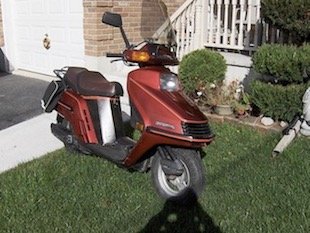
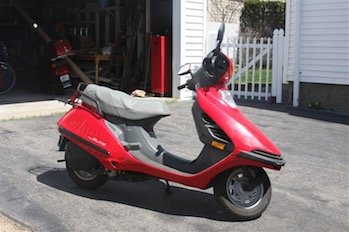 The Elite 150 was also redesigned for 1987, giving it a much more rounded shape (below). You don’t see very many of these scooters since they were only sold for one year in the USA market. This new Elite 150 was not brought to Canada so Canucks were left without the Elite 150 and Elite 80 after 1986.
MODELS: Aero 50, Spree, Elite S / R, Elite 80 (USA only), Elite 150 (USA only), Elite 250, Helix (USA only).
1988
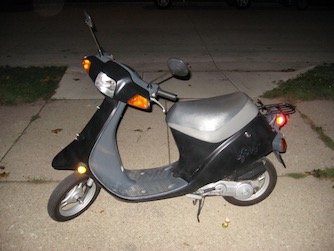 Following their 1987 actions in Canada, Honda discontinued the Helix and Elite 150 from the American market for 1988. It’s surprising that Honda dropped the redesigned Elite 150 after just one year. These changes left the Elite 250 as the lone large scooter in their lineup.
The biggest news for 1988 was the arrival of the new SA50 scooter in the USA market. This scooter was named both the ‘Elite LX’ and ‘Elite SR’, seemingly the name varied by year and state. This scooter replaced both the Aero 50 (NB50) and Elite S (SE50) which were dropped. The SA50 used a new frame and bodywork but continued to use the AF05E engine like the Aero 50 and Elite S. Canadians never did receive the SA50.
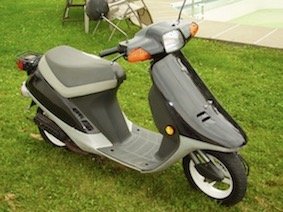 The other big news for 1988 was Honda’s replacement of the Spree (NQ50) with a new physically small scooter (Model Code: SB50). This new scooter was called the ‘Elite E’ in the USA and the Pal in Canada. This new scooter was quite a bit smaller but stylistically similar to the new Elite SR / LX. If you just look at pictures it can be hard to tell the difference but if you see them side by side then the differences are obvious.
Besides a stylistic resemblance, the SB50 did not share very many parts with the larger Elite LX / SR scooter. The SB50 utilized the same core engine as its predecessor, the Spree. Honda also sold a faster ‘Elite ES’ version of this new scooter in the USA in 1988 only.
MODELS: Elite R (Canada only), Elite SR / LX (USA only), Pal / Elite E / ES , Elite 80 (USA only), Elite 250 (USA only)
1989 – 1990
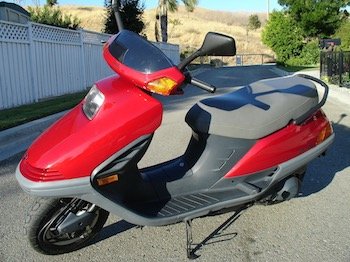 The Elite 250 received a full redesign for ’89 which included new styling, a new horizontal engine, underseat storage capacity and analog instrumentation. These final Elite 250 are really nice but rare examples. Interestingly, this was the last scooter ever sold to have a floorboard located rear brake. It seems these redesigned Elite 250’s were not sold in Canada.
Honda’s line remained unchanged for 1990.
MODELS: Elite R (Canada only), Elite SR / LX (USA only), Pal / Elite E / ES , Elite 80 (USA only), Elite 250 (USA only)
1991
With scooter sales in general remaining low, Honda discontinued the Elite 250 and the Pal / Elite E. Honda’s lineup for 1991 was pretty dismal compared to its mid 80’s glory. Canadians were offered just one – albeit awesome – 50cc, while Americans couldn’t buy a scooter bigger than 80cc. Thankfully these small Elite’s were darn nice scooters.
MODELS: Elite R (Canada only), Elite SR / LX (USA only), Elite 80 (USA only).

 1992 – 1993
For the 1992 model year, Honda responded to American enthusiasts cries to bring back the original maxi scooter, the Helix, to the American market. This scooter was last sold in the USA in 1987. Click here to download a PDF of Honda USA’s 1993 Scooter Lineup.
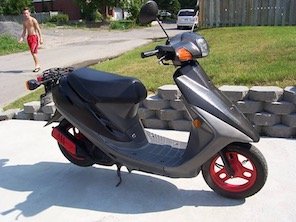
Honda also showed some attention to the Canadian market by replacing the aging Elite R with the fantastic 50cc 2-stroke Dio (SK50M). The SK50 Dio utilized a new and quite superior AF18E engine which was the first new 50cc 2-stroke engine offered in North America since the AF05E was introduced inside the ’85 Aero 50 (and later the SE50).
MODELS: Elite SR / LX (USA only), Dio (Canada only), Elite 80 (USA only), Helix (USA only).
1994 – 2000
Honda replaced the motor in the 50cc Elite for the 1994 model year with the superior ‘AF16E’ engine also found in the Canadian market Dio. They also dropped the ‘LX’ suffix, so all 1994 and newer SA50 were called Elite SR’s except for moped legal versions. With the introduction of the new motor, Honda added a moped legal version called the ‘Elite S’ in 1994 (code SA50P) that was capable of 30 mph. Do not confuse this scooter with the unrestricted 1988 SE50 which was also badged the Elite S. The new generation of Elite scooters are very popular with speed enthusiasts because the aftermarket parts scene is enormous that’s to the popularity of the AF16E motor in Asia.
Following the 1994 changes, Honda paid little attention to their stagnant scooter line for the next six years. Canada was only offered the Dio over this period, while American’s got to choose from the newer Elite S / SR or the aging Elite 80 and Helix.
MODELS: Elite S / SR (USA only), Dio (Canada only), Elite 80 (USA only), Helix (USA only).

 2001
2001
With interest picking up and added pressure from Vespa returning the North American market, Honda and Yamaha steadily bolstered their lineup by introducing several new scooters over the new few years.
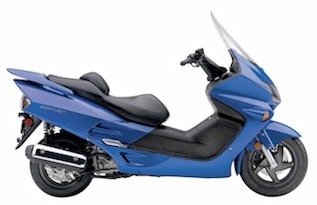
The first to be added was the Reflex (model code NSS250), which was conceived as a Helix replacement although the two scooters would wind up being sold alongside each other for much of the Reflex’s run. The Reflex was sold in two versions with the premium version offering ABS, a first for Honda’s scooters. The Reflex was the first all new scooter model from Honda since 1987 in the USA and 1994 in Canada.
MODELS: Elite S / SR (USA only), Dio (Canada only), Elite 80 (USA only), Reflex, Helix (USA only).
2002
For 2002, Honda continued to replace its long running models with newer and updated designs. Honda cut the Elite SR, Dio and Helix scooters from their lineup. The Dio and Elite SR were the last 2-stroke scooters Honda has sold in North America. They were replaced in Honda’s line up by the new retro styled CHF50.
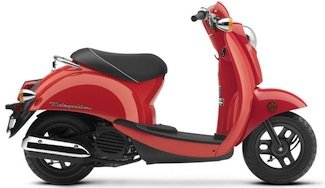 This CHF50 scooter was sold under the Metropolitan name in the USA and as the Jazz in Canada. This scooter is also known as the Crea and Scoopy overseas. With the discontinuation of the Elite SR, the Elite 80 was left as the last member of the Elite family and the last scooter from the 1980’s still on sale.
Designed to compete with other 2-stroke 50cc scooters (Yamaha’s Vino and Vespa’s ET2), the 4-stroke CHF50 was slower accelerating but a step ahead technologically with its cleaner and more efficient liquid cooled 4-stroke engine.
 This engine was a new 2-valve, carburated 4-stroke that included several technological advances. Specifically, it was the first liquid cooled 50cc scooter engine from Honda and it introduced a clever starting system that did away with the starter motor and instead used the silent alternator to start the engine.
Honda also released a restricted version of this new scooter in the USA called the Metropolitan II (CHF50P) that met moped laws in many areas. This scooter was restricted to 30mph via intake, variator and ECU restrictions.
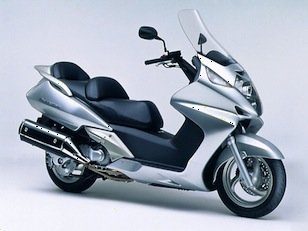
Honda made a second major announcement for 2002, the new 600cc Silver Wing maxi-scooter (aka FSC600). By far Honda’s largest scooter offering ever, the Silver Wing was designed to be a great touring machine and it offers excellent storage capabilities.
MODELS: Metropolitan / Jazz, Elite 80 (USA only), Reflex, Silver Wing
2003 – 2004
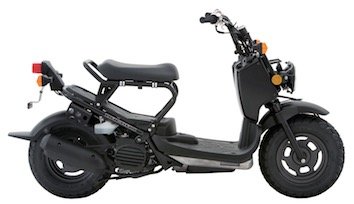 Honda released another landmark scooter to North America in 2003, the rugged styled Ruckus. The most significant attribute of the Ruckus was its radical styling which resembled no other scooter. The Ruckus shares the same basic engine/drivetrain as the Metropolitan / Jazz but its fresh styling attracted an entirely new audience to Honda. Since its introduction, the Ruckus has become very popular, with a large aftermarket parts scene now present.
One year after its second discontinuation, Honda USA again revived the aging Helix scooter for 2003 in response to enthusiasts cries who weren’t happy with the modern styled Reflex. This was the second time the Helix had been resurrected since its initial introduction way back in 1986.
MODELS: Metropolitan / Jazz, Ruckus, Elite 80 (USA only), Reflex,Helix (USA only, Silver Wing
 2005
2005
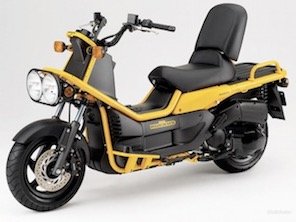
For the 2005 model year Honda introduced the ill fated 250cc Big Ruckus (PS250). Attempting to build on the success of the Ruckus, the Big Ruckus would sell poorly which was due in part to the high price tag, Honda’s decision to only offer it in yellow and styling that arguably lacked the charm of it’s smaller sibling.
Honda also added the ‘S’ version of the Ruckus (NPS50S) that got you a fancier paint job for an extra $50. In the first couple years, this fancy paint job was a camo pattern on the ‘battery box’ and matte metallic paint. In later years, the ‘S’ models would get colors like silver and matte grey.
MODELS: Metropolitan / Jazz, Ruckus, Elite 80 (USA only), Reflex, Big Ruckus, Helix (USA only), Silver Wing
2006
Honda revised the Metropolitan / Jazz and Ruckus scooters with a new crankcase ventilation system and a few other performance tweaks. As a result, top speed rose from about 37mph to 42mph and a serious problem with crankshaft bearing failure was eliminated. This crankshaft bearing problem resulted from poor crankcase ventilation leading to oil contamination. This problem affects 2003 – 2005 Ruckus’s and Metropolitan / Jazz scooters and it remains as one of very few quality issues Honda scooters have had.
MODELS: Metropolitan / Jazz, Ruckus, Elite 80 (USA only), Reflex, Big Ruckus, Helix (USA only), Silver Wing
2007
After two slow years, the Big Ruckus was dropped from the North American market, making the few that were sold rare scooters and likely a future collectors item.
Honda also dropped the restricted version of the Metropolitan called the Metropolitan II (CHF50P).
MODELS: Metropolitan / Jazz, Ruckus, Elite 80 (USA only), Reflex, Helix (USA only), Silver Wing
2008
The amazing 22 year run ended for the Elite 80 after the 2007 model year. With Honda’s new 50cc scooters offering nearly the same performance with modern styling at a lower price, apparently the Elite 80 became less attractive to buyers.
Honda also cut the Helix for a remarkable third time, making 2007 the last model year for both of these legendary scooters. Honda’s transition to a new generation of scooters models that started in 2002 was finally complete.
2007 was also the end of the line for the Helix’s poorly received replacement, the Reflex. It’s remarkable that the Helix managed to hang around right until the end of its replacement, the Reflex.
MODELS: Metropolitan / Jazz, Ruckus, Silver Wing
2009
High gas prices and a growing scooter market meant that 2008 was the best year yet for Honda’s small 50cc scooters. By mid-summer 2008, every dealership in the USA was sold out and Honda responded with an early release of the 2009 models in early August. Besides new color choices, Honda made no changes to their scooter lineup
MODELS: Metropolitan / Jazz, Ruckus, Silver Wing
2010
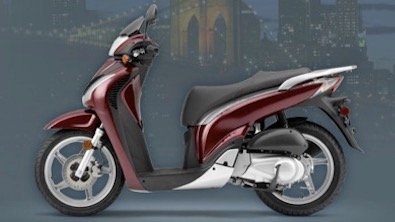 Honda announced two new scooters for the 2010 model year. The first to be announced was the mid-sized SH150i scooter which is being sold in the USA and Canada.. With the introduction of the SH150i, Honda returned to the mid sized scooter market for the first time since 1987 when it last offered the Elite 150.
Honda claims SH150i is the best selling scooter in Europe. This large wheel scooter offers excellent stability at high speeds, fuel injection, aluminum rims and liquid cooling. The SH150i is a distant descendant of Honda’s legendary Cub. Check out the SH150i page for more info.
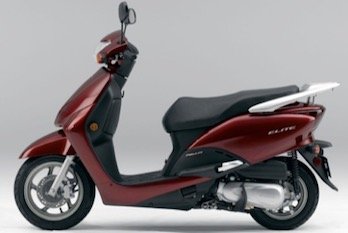 Further strengthening Honda’s USA mid-sized scooter offerings was the second new model, the 108cc 2010 Elite. Also featuring liquid cooling and fuel injection, this small wheeled scooter aimed to be a practical urban runabout with huge storage, great milage and peppy power for scootering around town. This new Elite 110 was the first new scooter in Honda’s Elite family since the 1988 Elite SR/LX. Check out the Elite page for more info.
Due largely to the 2009 recession, Honda decided to skip the 2010 model year for their existing scooter models (Silver Wing, Ruckus, Metropolitan/Jazz) so they could clear out the backlog of inventory. The scooter market saw a 50% sales drop in 2009.
MODELS: SH150i, Elite 110 (USA Only)
2011
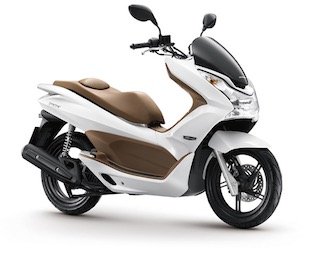 In fall, 2009 Honda announced a new scooter, the 125cc PCX, as a worldwide model and scheduled it to be introduced in North America in spring 2010. This was confirmed May 12th, 2010 when Honda officially announced the PCX as a 2011 model in the USA. The PCX featured fuel injection and a front disc brake. For 2011 the PCX was not offered in Canada.
Also announced on May 12th, 2010 was the return of the Ruckus. After apparently selling through the backlog of 2009 models created by the recession, Honda USA reintroduced the Ruckus as a 2011 model. No changes were made to the Ruckus besides the addition of a new orange/black color scheme.
On October 5th Honda announced the 2011 Silver Wing for the USA market. The 2011 Silver Wing gained a new color (‘Classy Black’) and became available only as an ABS model.
The Metropolitan/Jazz and the SH150i were discontinued for 2011, although a new generation of Metropolitan would return for 2013.
In the Canadian market, only the Ruckus was announced for the 2011 model year. Honda’s other long running scooters (Jazz, Silver Wing) were skipped for 2010 here. As of fall 2011, the Silver Wing is gone from Honda Canada’s website and the Jazz and SH150 are being offered a deep discount, so we can safely assume none of these scooters will be back anytime soon in their current form.
MODELS: Ruckus, PCX 125 (USA Only), Silver Wing (USA Only)
2012
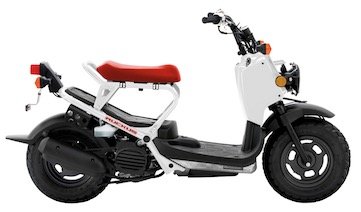 Honda USA’s scooter lineup was down to just the Ruckus and Silver Wing for 2012 with the PCX 125 being skipped for 2012. In Canada the Ruckus was again the lone 2012 offering, as they were still clearing out surplus inventory for 2010 at a deep discount.
The only good news for 2012 was the release of a white/red version of the Ruckus (or 10th Anniversary Model as Honda Japan called it). This version of the Ruckus was white with red decals and a red seat. Some red grips and red rims from an 80’s Elite R (SE50) would look really sharp here.
MODELS: Ruckus, Silver Wing (USA Only)

 2013
2013
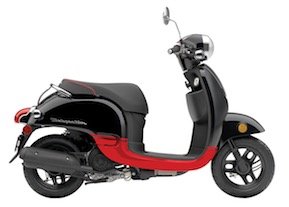
Honda USA got an early start for 2013 when they announced a new generation (NCH50) of their Metropolitan scooter in April 2012. Honda Canada followed suit a couple months later and but introduced this scooter using its Asian market name, the Giorno.
The 2013 Metropolitan / Giorno was an all new model (NCH50) that uses a new frame, engine and body. The new style and addition of fuel injection were a plus, while the air cooling and steel tube frame were a step back from the previous generation. These changes lowered the cost of the scooter, which allowed Honda to lower the MSRP by $50.
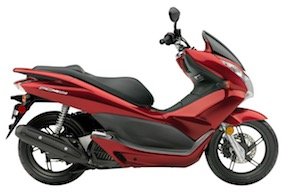 Honda USA also announced the return of the PCX for 2013, this time around with a bigger 153cc mill and a commensurately revised name: the PCX 150. This updated PCX was now freeway legal in all USA states. For the first time, Canadians were offered the PCX as well, with it being added as a 2013 Canadian model in September 2012.
Finally, the Ruckus snuck into Honda’s 2013 line in mid-November with no changes. There wasn’t even the usual reworked palette of colors, so Black or White/Red were the options again.
MODELS: Ruckus, Metropolitan / Giorno, PCX150, Silver Wing (USA Only)

 2014
2014
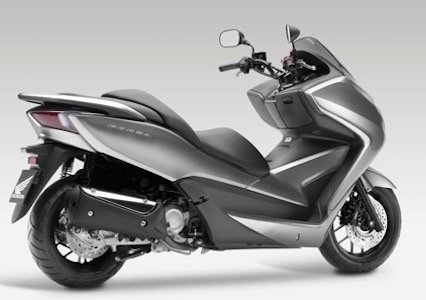
Honda fired the first salvo of their 2014 line with a super early announcement of the 2014 Forza (Fall 2012 in Canada, May 2013 in the USA). The new Forza (NSS300) was a replacement for the Reflex (NSS250), but this time around Honda opted to stick with the Asian name. The Forza was an entirely new scooter that outshone its predecessor with crisper lines, beautiful rims, an extra 30cc and fuel injection. Also new was the 4-valve engine design and ABS, the latter being standard in Canada ($6399 MSRP) while adding $500 to the base $5599 MSRP in the USA.
In traditional November release season, Honda announced 2014 versions of their population Metropolitan and Ruckus for the USA and Canada. The Metropolitan got a new assortment of colors, with 2014 options of Pink Metallic (with white accents), Pearl Blue (black accents) and Candy Orange (black accents). Conversely, the Ruckus was back for the third year with the same two color options: Black and White/Red.
Missing for 2014 was Honda’s Silver Wing and PCX150. Both of these omissions were surprising, as the Silver Wing has been around since 2002 and was seemingly immortal, while the PCX 150 appeared to be a strong seller for Honda.
MODELS: Ruckus, Metropolitan / Giorno, Forza
2015
A heavily revised PCX150 returned in summer 2014 as Honda’s first 2015 model. Honda took the initiative to rework the styling and tweak the motor for an extra 0.4 HP (13.4 HP total). Also new are features like a larger glovebox, a 12V power port in the glovebox, a redesigned seat, new gauges, all LED lighting including the headlight and a larger fuel tank.
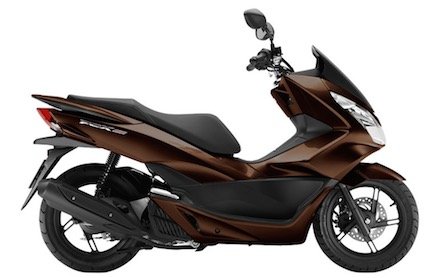 The new PCX arrived in July 2014. American’s can choose from black or white, while Canadians are being offered red or mahogany. USA pricing is unchanged from 2013 at $3449, while Canadian pricing is $3899.
In early November, Honda announced the rest of their lineup. The Ruckus, Metropolitan/Giorno and Forza are all returning with the same MSRP’s. Colors for the Ruckus and Forza are the same, while the USA market Metropolitan gets a white/grey color option instead of Candy Orange/Black. In Canada, Honda changed or embellished some of the color names (i.e. Pearl Blue is now Pearl Gemini Blue, Metallic Pink is now Spica Pink) but the actual pigments remain unchanged.
MODELS: Ruckus, Metropolitan / Giorno, PCX150, Forza
2016
Having released the 2015 model year of the PCX 150 early in summer 2014, Honda ran out of stock and ended up pulling a similar move with the 2016 model. Honda announced the 2016 PCX 150 model in late May 2015 with stock arriving in dealerships soon after. The 2016 PCX 150 carries over unchanged from the year prior aside from new colors and a $50 increase in MSRP to $3499 ($100 increase to $3999 in Canada). The new colors are a darker red called Dark Cherry Red and Steel Grey, although on the latter is headed to Canada using the longer “Matte Techno Silver Metallic” name.
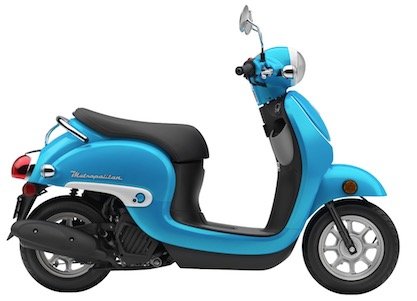 Honda announced the return of the rest of their models (Ruckus, Metropolitan, Forza) in November 2015. The big news is updates to the Metropolitan (Giorno in Canada). For 2016 the Metropolitan makes the switch back to a high compression liquid cooled motor like the first generation. It also gets an in-floor fuel tank allowing for larger underseat storage and the amenities are re-worked in the legshield with a new glovebox including a 12V charging port. The style is also freshened with new rims and tweaks to the flanks, gauges and legshield. Along with the new features comes a $400 price jump to $2399 (USA). 2016 colors are Pearl Blue (shown) along with Pearl White and Red.
The rest of Honda’s line (Ruckus and Forza) returned for 2016 with no changes to even color options and pricing.
MODELS: Ruckus, Metropolitan / Giorno, PCX150, Forza
2017
Like the last two years, Honda released next year’s PCX 150 in early summer – making the announcement on June 9. For 2017 the PCX returns unchanged except for an additional $100 on the price tag, which is now $3599. The lone update is new color options, which are white and a nice new pearl blue.
The 2017 editions of Honda’s small scooters – the Ruckus and Metropolitan/Giorno – were announced in November for the USA market. These models return without any updates other than a $50 increase in price to $2699 (Ruckus) and $2449 (Met). Honda didn’t even change the colors options for either model. The Ruckus has offered the same two colors (black or white/red) for 6 years now, so it’s pretty clear Honda’s days of paying attention to Ruckus are over – not that this iconic scooter needs any changes. After 15 years the Ruckus is entering classic territory. The Metropolitan/Giorno was updated last year so it’s less due for an update.
Sadly, Honda omitted the Forza from their 2017 line up in both the USA and Canada, ending this fine scooters run at 3 years (2014 – 2016).
MODELS: Ruckus, Metropolitan / Giorno, PCX150
2018
Honda has been releasing new model years of the PCX150 quite early, and for 2018 they took it to a new level with an April 2017 release. These 2018 models are identical to the 2017s in every way, including mechanics, price and color options.
In the traditional fall release season Honda announced the return of the Metropolian and Ruckus. The USA got some new colors for the Metropolitan but that was the only change. In Canada only the Ruckus returned.
MODELS: Ruckus, Metropolitan / Giorno (USA Only), PCX150
2019
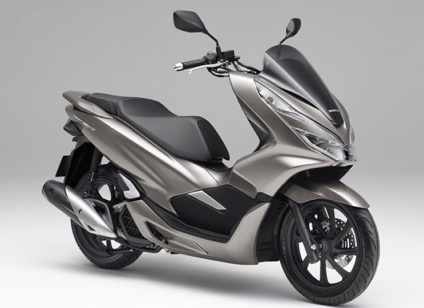 In April, 2018 Honda USA announced a new generation of PCX 150 for a June release. This 2019 PCX 150 becomes the third generation offered in the USA since the first PCX was offered here for 2011. The third generation PCX 150 offers improved handling through a lighter frame, tuned suspension, wider tires and optional ABS (for an extra $300).
The 2019 PCX also offers new curvier styling, an impressive LCD dash display and heavily re-worked motor. Unfortunately there is only a single color option for 2019 (Bright Bronze). See the announcement here, or visit the PCX 150 page for more details. Thus far there is no indication that it is headed to Canada.
The rest of Honda’s scooters returned largely unchanged. The Ruckus returned to both Canada and USA, while the Metropolitan continues to be offered in the USA only but with a new pastel blue color option (Coastal Blue) replacing the darker blue option (Denim Blue Metallic).
MODELS: Ruckus, Metropolitan / Giorno (USA Only), PCX150 (USA Only)
2020
Honda returned their scooter lineup unchanged for 2020 with three models in the USA and only one in Canada.
MODELS: Ruckus, Metropolitan / Giorno (USA Only), PCX150 (USA Only)
2021
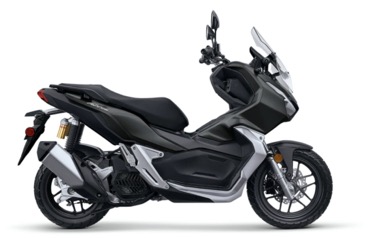 Honda announced the ADV150 as an early release 2021 model and their first “adventure” scooter.
The ADV150 arrives in the USA for $4299. It includes a 2-position windscreen, dual Showa shocks, and powertrain powered from the PCX150 – which is about as good as it gets.