
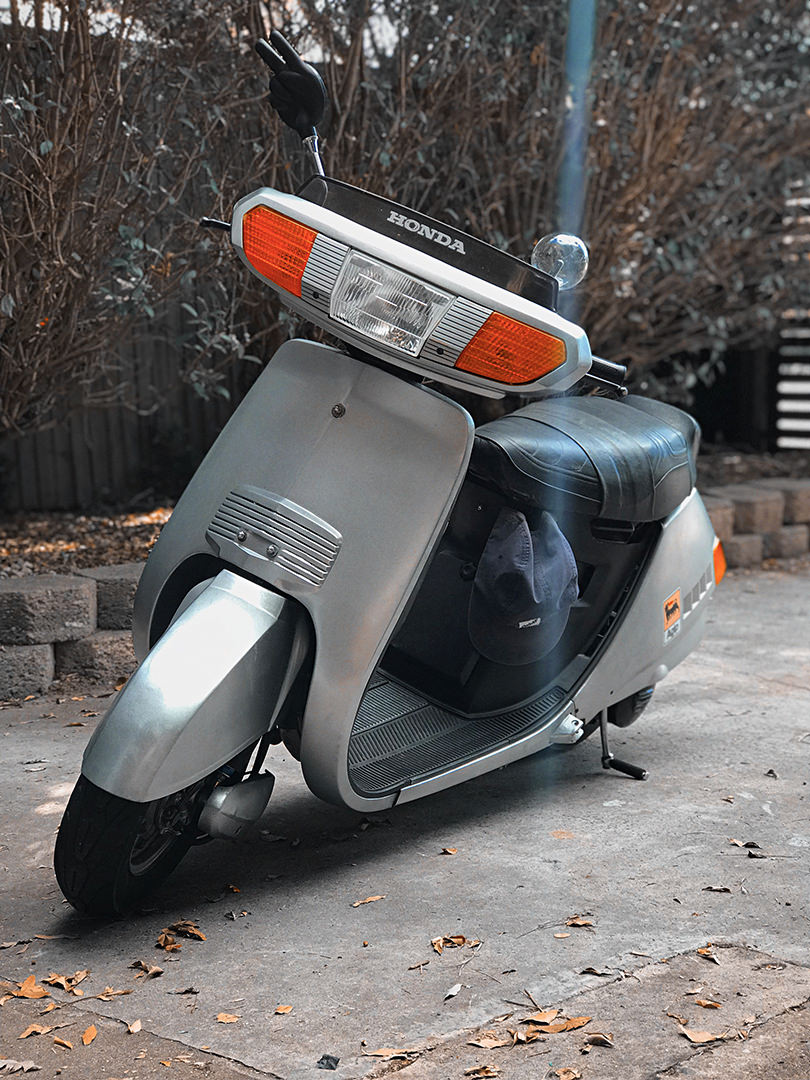
HONDA AERO 80 / MASCOT (NH80)
The Aero 80 (NH80) was sold in North America (except California) from 1983 to 1985. This scooter was powerful, reliable, comfortable and a blast to ride. This scooter oozes that quirky 80’s style, which combined with the extremely peppy engine stamps a grin on any rider. This scooter is not without its flaws, but it’s a great scooter to pick up if you can find one cheap in your local online classifieds.
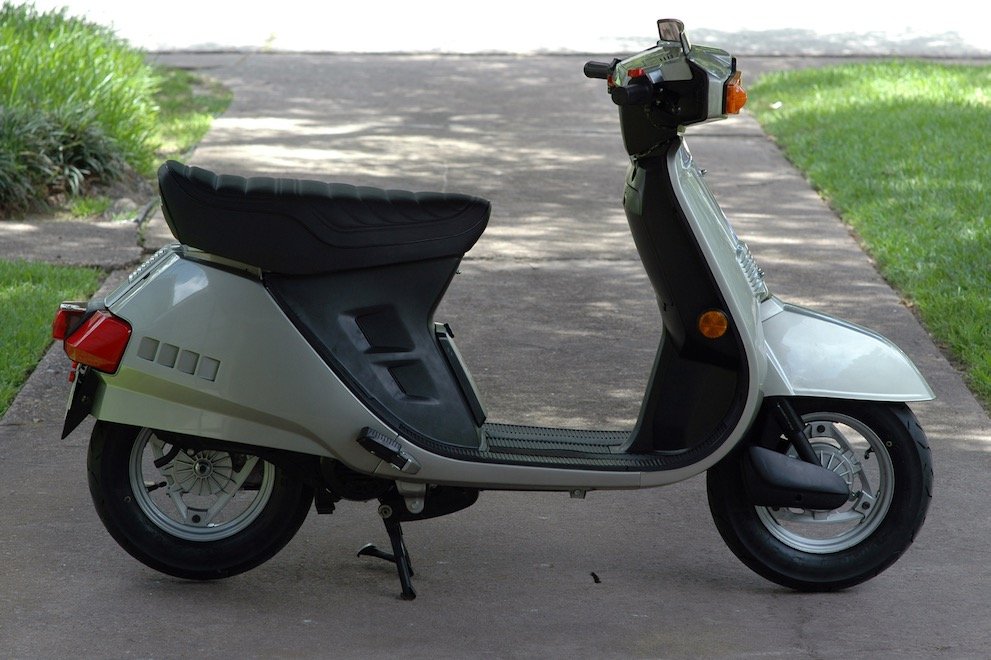
Some Canadians may notice their NH80 badged as a ‘Mascot’ rather than an Aero 80. For some reason, some ’83 and ‘84 NH80’s sold in the Canadian market received this name while others were called Aero 80’s. It’s possible these scooters were diverted from another market or perhaps Honda decided some parts of Canada might like the Mascot name better? Seemingly no 1985 models used the Mascot name in Canada.
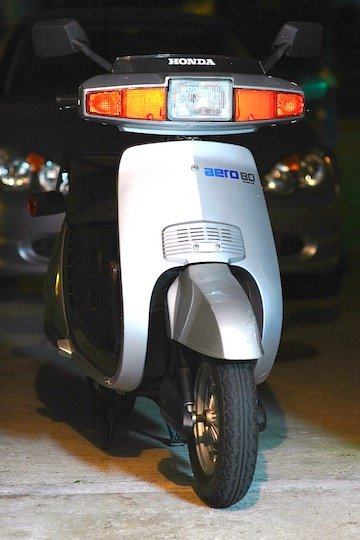 Elsewhere in the world, the NH80 was sold under the ‘Lead 80’ name. After the NH80 was discontinued in North America, it was redesigned in the late 80’s and rose from 80cc to 90cc (Lead 90). Later it was redesigned again to 100cc and finally the motor was switched to a 110cc 4-stroke and the name became the Lead 110. It was this 110cc model that returned to the USA for the 2010 model year as the Elite 110. So really, the newer Elite 110 was actually a continuation of the NH80 line.
Honda also teamed up with Peugeot to create the Peugeot SC 80 scooter which was based on the NH80. This scooter was sold from 1983 – 1987 and was followed up with the Peugeot SX80 which was based on the next generation Lead scooter which we didn’t get here. The SX80 was sold from 1988 to 1992.
Engine
The NH80’s 80cc 2-stroke engine is very peppy, enough so that if you slide to the back of the seat and crank the throttle open you can easily wheelie off the line. Check out this YouTube video of an NH80 owner wheeling. Here is another video that is a nice video tour of a Aero 80. Yamaha’s competing CV80 is so much slower that the difference in acceleration is night and day. One of the reasons why the NH80 is such a peppy scooter is that it has the first ever 5 port 2-stroke engine found in a scooter and Honda never bothered to muzzle it to make it ‘easier’ to ride. This results in an impressive 6.5hp at 6500 RPM, as shown in graph form by a rare Australian NH80 brochure. This graph reveals that the NH80 makes in excess of 5 horsepower all the way from 4500 RPM to 8500 RPM. The NH80 redlines at 9000 RPM. The torque curve is also impressive. The NH80 peaks at 5.8 lbs/ft at 5000 RPM and it makes 75% of this at just 3000 RPM. This is likely where the wheelie power comes from.
 Despite being very peppy, the NH80 tops out at only 40-43mph which is a decent top speed but you know it makes enough power to do quite a bit better. It rockets off the line and accelerates satisfyingly but it starts to run lean on the top end which cuts off the power around 40mph. Unlike a lot of other 50cc scooters that can also achieve 40mph, the NH80 makes a lot of mid range power so it can hold it’s 40mph top speed even up decent hills. This top end lean condition can also result in the power cutting out at full throttle A quite few NH80’s seem to require careful throttle manipulation at about 80% throttle to achieve optimal acceleration. This full throttle cutting out can be remedied by replacing the 88 main jet with a 90 main jet in the carb. The NH80 is not physically restricted (ie. a redline). My brother (shown at left) has an aftermarket carb/intake/reeds on his and now it does 45-50mph and can hit close to 60mph down hills. The updated ’85 NH80’s are slightly faster than the earlier years and are good for 43-45mph. The full throttle cut out was also fixed with the new carb needle profile. On the downside, 1985 models lost the kickstarter found in the ’83-’84 models.
1985 Revisions
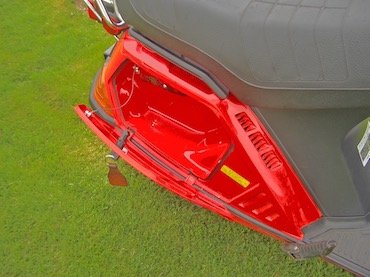 Honda updated this scooter for 1985 to make it even better. Most importantly, they redesigned the muffler to make it way smaller and in doing so, freed up enough space to make a super handy storage compartment possible in the right side panel (shown at right). Honda also made some changes to the styling. They introduced new rims (which also found their way onto the Elite 80). Honda ditched the external rear blinkers and replaced them with new blinkers integrated into the body of the scooter above the rear bumper. The rear rack was changed from a black plastic rack to a chrome one. Interestingly, this new rack and even the entire rear end are virtually identical to the new Elite 80, which also debuted for ’85. Most of the parts are the same.
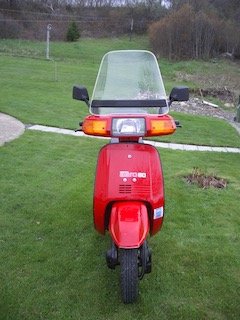 Perhaps most noticeably, Honda changed the look of the front headlight array (new array shown at left). This new front end is more similar to the larger Aero 125 scooter. I prefer the newer array, but both versions are nice. Honda also changed the look of the dash gauges for ’85 so they are similar to the Elite 80’s. The front reflectors (between the headlight and front blinkers) on the early (’83 – ’84) NH80’s are prone to falling off and have been discontinued by Honda so replacements are hard to find.The ’85 NH80 has the reflectors integrated into the blinker lens, so there’s no danger of this happening. The NH80’s headlight array may look awkwardly wide, but it actually serves a very useful purpose as a wind guard for your hands. This comes in handy on cold trips.
Storage & Convenience
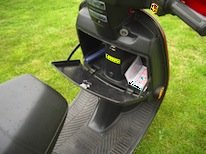 All Aero 80’s have a glovebox (below right), which is quite a nice size. You could fit a quart of 2-stroke oil and a travel mug of coffee in here. There is also a bit of storage under the seat but only enough to keep a spark plug or two and a couple small wrenches. Most of the underseat space is occupied by the gas tank the vertical engine design. This minimal underseat space is what makes the new side panel storage found in 1985 models so handy.
Honda dropped the Aero 80 after 1985 in the North American market, so these improved NH80’s were only sold for one year and thus are fairly rare. A low mileage example is definitely a good pickup if you can find one. Even one with 10-15,000 miles should still have a lot of life left if its been treated well.
 The NH80 is extremely reliable. My brother has over 40,000kms (24,000 miles) on his NH80 (the speedometer pictured at left shows his odometer rolling over for the 4th time). Another Canadian NH80 owner has 60,000kms (36,000 miles) on his with virtually no repairs.
One downside to the Aero 80 is that local regulations and insurance companies may charge you more than they would for a 50cc. If you don’t plan on carrying passengers and you’re not a larger rider, the Honda’s Aero 50 might be a better choice if this is a concern. The Aero 50 isn’t quite as fast but it’s close and every model year has the super handy side panel storage than the NH80 only got for ’85. The Aero 50 is good for about 40mph whereas a properly running Aero 80 tops out around 43-44 mph. The Aero 80 is also a bigger scooter with a better suspension so it’s better for bigger riders or 2-up riding. Another scooter to consider is Honda’s 4-stroke Elite 80. The Elite 80’s top speed is similar but the Aero 80 accelerates much faster, so it’s more fun and better equipped to handle two passengers. The Aero 80 also has more storage capacity.
Aftermarket Options
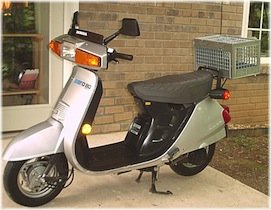 If you’re itching to reduce the reliability of your scooter with aftermarket parts, the Aero 80 isn’t the best scooter to start with. The only bolt on parts available for the Aero 80 were actually designed for other scooters and just happen to fit the Aero 80. Most notably, Honda’s AF16E engine uses the same intake manifold bolt pattern as the NH80, so you can buy aftermarket intake manifolds, reed cages and carbs intended for these scooters. The scooters that Honda sold here that use the AF16E engine are the 1992 – 2001 Honda Dio (SK50) (sold only in Canada and overseas) and the ’94 – ’01 SA50 Elite (aka Elite SR, Elite 50). The carburetor in the Aero 80 is quite small for an 80cc 2-stroke, so going with an improved reed cage, intake manifold and carburetor should raise your top speed to 45-50mph. My brother has done this modification with good results but moderate decrease in fuel mileage.
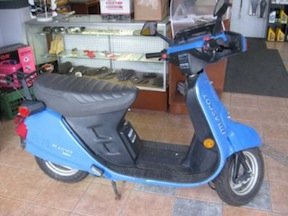 The other noteworthy part you can bolt into your Aero 80 is a Wiseco piston from an 1983 Honda CR80 dirtbike. If you want a bit more power or just want to rebuild your engine, you can pick up one of these pistons and get your cylinder overbored and honed to suit. You will also need the wrist pin for the CR80. The CR80 pistons come in several bore sizes (so you can keep going larger as your cylinder wears out). The Aero 80’s stock bore is 48mm and you can get the CR80 pistons from 49.5 to 51.5mm. These pistons would bump your Aero 80 to 82 – 90cc depending on the size you choose.
Besides the above mentioned parts, you’re on your own for making this scooter faster. Some owners have custom made their own expansion chamber pipes (which help a great deal) or they have modified an exhaust from a CR80 dirtbike to fit. You could also play with the ignition timing to add a bit more juice. Realistically though, the Aero 80 makes great power in its stock form. Simply adding the AF16E intake manifold, carb and reeds and gearing it a bit taller (via a larger rear tire) provides a nice top speed boost while preserving reliability.
The Aero 50 on the other hand has a better selection of aftermarket parts. These parts are described in depth here, but basically you can get 70cc big bore kits, CDI’s, variators, clutches etc. On the flip side, the Elite 80 has even less parts despite being sold here for over 20 years. The only aftermarket part for the Elite 80 is an exhaust from Battlescooter which is primarily for looks. The Elite 80 was not a big scooter in the Asian market where most aftermarket parts come from, which is why you can’t get parts for the Elite 80.
Comparison
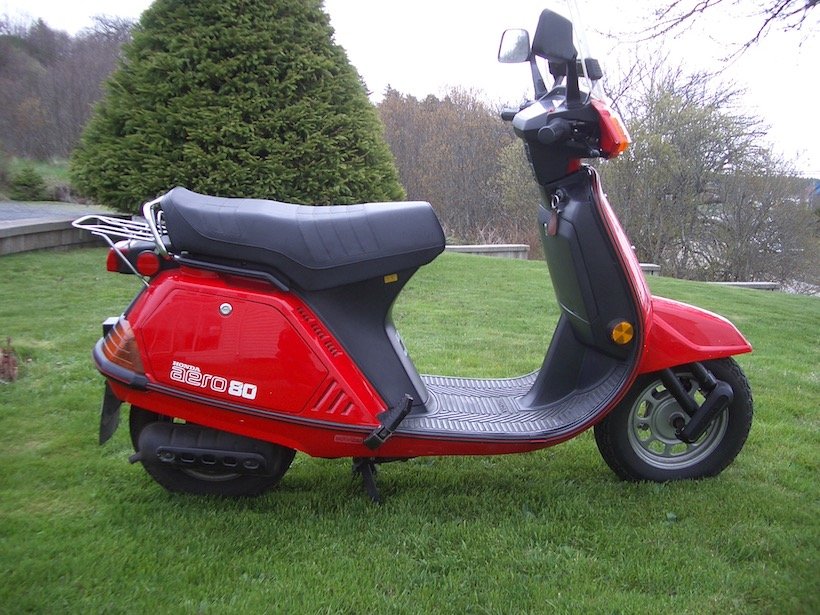
If you’re in the market for an 80’s Japanese scooter, the NH80 is an awesome choice. You can probably find one for a similar price as a 50cc, but you’re getting a peppier scooter that is very reliable (due to its low stress engine). I suspect the NH80 is faster to 30mph than any other 50cc or 80cc scooter sold in the 80’s. If having an 80cc scooter is not going to pose insurance or licensing problems for you, the NH80 is a great way to go. In my books, the ’85 NH80 is pretty much the pinnacle of fun and low cost scootering. You can pick these scooters up for under a grand normally and it’ll go forever. You might have some initial issues if it’s been sitting for a long time (like old gas, clogged carb jets, bulbs burning out, rusty fuel tank etc) but once these are sorted out your NH80 should be bombproof. The ’83-’84 NH80’s are awesome and the additional storage and upgrades made for ’85 puts it right over the top.
Other scooters worth considering are the Elite 80 (slower, but better MPG), Yamaha’s Riva 80 (slower, retro styling) or a 2-stroke 50cc like Honda’s Aero 50 or Yamaha’s Riva 50 or Jog. A 50cc scooter will lower your insurance bill and possibly save you from having to get a drivers licence, and you can boost the power of a 50cc to about that of an NH80 using aftermarket parts, but there’s no beating the reliability of a scooter that makes good power in its stock form.
Pros:
- Very peppy, you’ll be able to keep up with cars around town on this scoot.
- Comfortable
- Super reliable
- Storage Space (especially the ’85 models)
Cons:
- Higher insurance than a 50cc
- Not moped legal
- Very little aftermarket parts, some OEM parts not available
Links:
’83-’84 Aero 80 Service Manual – Essential for working on your Aero 80
’85 Aero 80 Service Manual – These Honda manuals are amazing. Download this.
Aero 80 Ads and Brochure Scans – Neat stuff from the creative minds at Honda in the 80’s.
MotorscooterGuide Forums – Visit the forum on this site to chat about your scoot.
MyScoot – Aero 80 Pages – Great information on fixing up an NH80 and even modifying it for more speed.
Maintenance Schedule – Here’s the proper maintenance schedule as recommend by Honda.
NH80 Australia Brochure – A nice 4 page brochure on the NH80 from Honda Australia
ScooterTuning.ca – An online scooter shop with many Aero parts
Key Specs:
- Engine: Air-cooled, 79.5cc two-stroke with automatic oil injection
- Bore & Stroke: 48 x 44mm
- Compression Ratio: 6.8:1
- Power: 6.5hp @ 6500 RPM, 5.8 lbs-ft torque @ 5000 RPM
- Ignition: Capacitor Discharge
- Carb: 16mm Slide
- Transmission: Honda V-matic variable ratio and automatic clutch
- Drive: Belt
- Starter: Electric and Kick
- Accessory: Rear carrier
- Wheelbase: 46.1” / 1170mm
- Length: 67.5” / 1715mm
- Width: 26.7” / 680mm
- Height: 41.3” / 1050mm
- Ground Clearance: 4.3” / 110mm
- Seat height: 28.7” / 730mm
- Dry Weight: 165.4 lbs
- Wet weight: 181lbs / 82 kg
- Max Load: 335lbs
- Fuel Economy: 32km/litre, 75 mpg
- Fuel Tank: 5.3 litres / 1.4 gallons
- Oil Tank: 1.2 litres / 0.3 gallons
- Spark Plug: NGK BPR6HSA
- Wheels: Cast Aluminum
- Tires: 3.50 x 10 4PR (Front and Rear)
- Front Suspension: Bottom Link
- Rear Suspension: Swing unit, single shock
- Brakes: Drum / Drum
- MSRP: $828 (1984)
Colors:
- 1983: Stream Red (R116), Starlight Silver (NH131),
- 1984: Moonlit Silver (NH137), Candy Ruby Red (R4C),
- 1985: Capri Blue (B106), Monza Red (R110)